
I Screamed at Simon Sinek in an Airport—and Almost Got Escorted out by TSA
Here’s the story of one of my biggest mistakes.
This was not just some cute little “oopsie.”
This was a full-blown Monique meltdown in the Chicago O’Hare airport (which I also not-so-lovingly refer to as “purgatory with a Cinnabon”).
An emotional combustion for which I probably would have gotten fired had I not been working for the expert in communication and employee empathy.

For context: I worked for Simon Sinek for almost a decade.
And in case you’ve been living under a rock and have no idea who Simon is—he’s a New York Times and Washington Post bestselling author, thought leader, and TED Talk celebrity. He is one of the most sought-after speakers in the world.
And I was his assistant—literally the “Chief of Simon.” I took care of his speaking bookings, his correspondence to the world, his travel, his schedule, his production, his everything. I traveled with him and I managed the behind-the-scenes machine.
Now, back to the story of my not-so-subtle blow up, which takes place early in my second year on the job. I felt like I was grooving. I had a handle on things. I was performing.
(And that’s an important word here: performing.)
Simon and I were standing in line at the Chicago airport after an insane week, bouncing from city to city, airport to airport. We were both absolutely wiped out.
But just because I was traveling with Simon as his “Producer” doesn’t mean my other responsibilities got put on hold. I was also doing my “regular EA duties” on the computer, because here’s the adorable thing about email: it does not care that you’re in another city, in another time zone, running on fumes, and eating airport almonds for dinner.
The emails just keep coming.
This particular week, we had not had a solid opportunity to go through my (beloved) list of to-do’s, and I could feel that little nagging pressure building inside me.
Every second, the list was growing! I could feel the decisions piling up—that heavy weight of responsibility.
(Assistants—you know what I’m talking about.)
And, as we were standing in line for TSA Precheck, I had what I thought was the most brilliant idea:

Hmm… we’re just standing here.
At 9pm.
In an airport.
After this introvert just wore out his social battery at events all week.
Why not take the opportunity to pummel him with questions about major decisions he needs to make about his future life and work?
And he can’t get away or deflect. He’ll HAVE to answer all of my questions!
OMG. This is going to feel sooooo good.
A beautiful, healthy, strategic partnership decision, of course.
I pulled out my trusty notebook from my bag and turned to face Simon.
And the poor man—I kid you not—sighed deeply and literally shrank away from me.
Now, a properly regulated person may have paused there.
A self-aware person may have thought, “Hmm. My executive sounds exhausted. Maybe now is not the time.”
But not Airport Monique.
Airport Monique had a list.
And I started throwing it at him.
I pummeled him with question after question, barely stopping to breathe, because that is one of my spiritual gifts. ✨
In the midst of the onslaught, Simon looked at me, exhaustion weighing heavy in his eyes, and simply said: “Not now, Monique.”
That was it.
Three words.
Not now, Monique.
But what I heard?
You’re stupid. Your job is stupid. Everything on your list is stupid. Your work doesn’t matter. You’re just a minion who color-codes my calendar.
Was that what he said? Not even close.
But that was absolutely my interpretation.
Because I already had a story in my head.
I was already carrying a narrative that he didn’t really value what I did. I was already sensitive to the fear that I was just there to make things pretty, then move things around, and keep the machine running quietly in the background.
So when he said, “Not now,” I didn’t hear a tired human being setting a well-deserved boundary.
I heard confirmation of my worst fears.
And I lost it.
I started saying screaming things like: “YOU DON’T RESPECT ME OR WHAT I DO. I’M JUST SOME SECRETARY TO YOU! YOU DON’T CARE ABOUT MY WORK.
WHAT DO I HAVE TO DO TO SHOW YOU THAT I’M VALUABLE!?”
Just. Utter. Nonsense.
I’m yelling at him. He starts yelling at me. The TSA agent literally threatens to kick us out of line and, when I don’t calm down, not-so-politely asks if I would like to accompany him into one of those doorknobless rooms I can only assume they use for stripdowns and interrogations.
Needless to say, I kindly declined the invitation and calmed myself enough for him to allow us through the metal detectors.
As we started walking toward the gate, I remember wiping away tears so Simon wouldn’t see me crying.
And then, (because apparently I had not embarrassed myself enough already) I barked: “What’s your problem?”
And, by some miracle, instead of firing me, Simon very calmly responds: “I’m so tired. I’ve used up all my energy today and I couldn’t answer your questions the way I needed to. I don’t do things like you do. I need rest. I’m sorry.”
… Sooo, you know that feeling when you suddenly realize an argument was completely your fault? ✋😅
At that moment, everything came to a screeching halt and I realized:
This is not what a healthy partnership looks like.
I knew something had to change.
And I knew that something was me.
Not only him.
Not the job.
Not the travel.
Not the list.
Me.
I had to become a better version of myself.
That moment forced me to look at the difference between getting things done and building an actual partnership.
(Spoiler alert: those are not the same thing.)
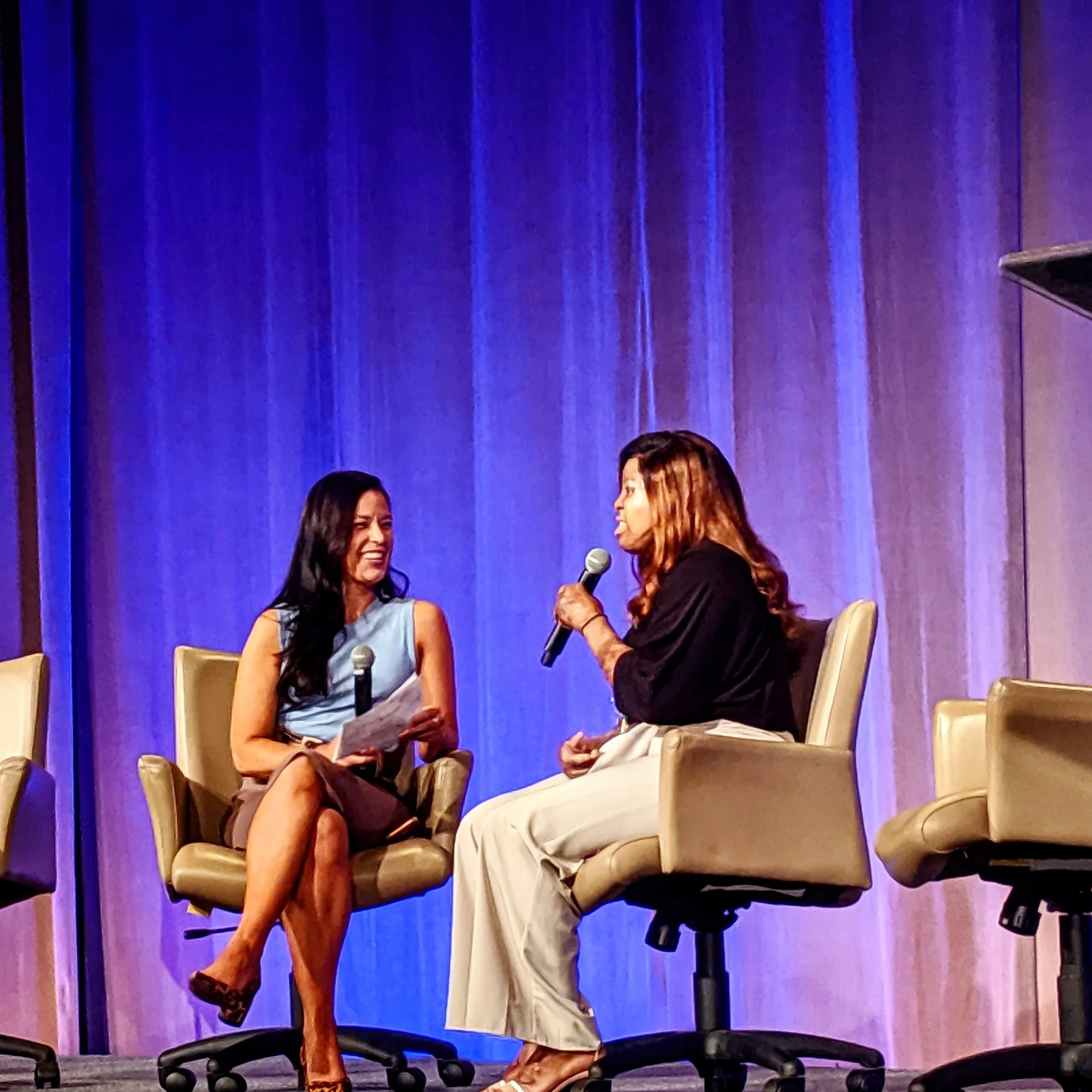
Monique Helstrom speaking with Kechi Okwuchi at the 2019 MillSummit
Here’s What Communication Really Means
Most Executive–Assistant partnerships get themselves in trouble because they think communication is just the transfer of information.
“Did I tell you the thing?”
“Did the calendar invite go out?”
“Did the follow-up happen?”
“Did you remind me?”
But communication is not just what you say. It’s what the other person can receive, process, understand, and act on.
That means timing matters. Tone matters. Energy matters. Context matters. Emotional state matters.
And yes, I know. It can be annoying. Because sometimes you just need the answer.
Sometimes the assistant is sitting there with 17 open loops, 43 follow-ups, three people biting for decisions, a calendar that looks like it was designed by Jackson Pollock, and an executive who keeps saying, “Can you handle that?”
Handle it how, sir?
With witchcraft?
Or the invisible instruction manual you forgot to give me?
But on the other side, executives are often walking around with brains that look like Times Square. They are making decisions all day, absorbing pressure all day, context-switching all day, and by the time their assistant shows up with “just a few quick questions,” their nervous system is already halfway out the window.
Both things can be true.
The assistant may genuinely need answers. The executive may genuinely not have the capacity to answer in that moment.
The problem is not that either person is bad at their job.
The problem is that nobody is communicating what is actually happening or what they’re actually feeling.
That is where accountability comes in.

Accountability Means Owning Your Part Without Turning Yourself Into the Villain
Let’s be clear: taking accountability does not mean blaming yourself for everything. And it doesn’t mean saying “I’m sorry” 37 times a day.
Accountability means I can look at a situation and say: “What part of this belongs to me?”
Not: “How do I make this entirely my fault?”
Also not: “How do I prove this is entirely their fault?”
The truth is: That airport fight with Simon was not only my fault.
He had responsibility too.
He could have helped create a better rhythm with me for decisions. He could have said, “I know you have a list. I can’t do it right now. Let’s do 20 minutes tomorrow morning.” Or he could have answered some of those same questions four days beforehand when I had emailed them to him.
That would have helped—but I also had responsibility.
I ignored the data in front of me: He was tired. We were in an airport. We had been traveling all week. He literally groaned when I pulled out the notebook.
That was not a subtle signal.
And I blew right through it because I was focused on my list.
I was performing.
I was not partnering.
And that distinction matters.

The Task Loop Is Where True Executive-Assistant Partnerships Go to Die
The biggest trap in the Executive–Assistant relationship is the task loop.
The assistant performs tasks. Then the executive gives more tasks. Then the assistant gets better at doing tasks. So, the executive trusts them with more tasks.
Everyone looks busy. Everyone looks productive… And the partnership never grows.
This is where many assistants get stuck. They become excellent executors, but they never become true strategic partners because the whole relationship is built around completion, not contribution.
The assistant waits for direction. The executive waits for the assistant to “step up.”
The assistant thinks, “I don’t want to overstep. They’re the leader. They know what I can do, so I’ll just wait for them to give me things to do.” The executive thinks, “Why aren’t they thinking ahead? Maybe they’re not capable.”
And nobody says what they’re actually thinking out loud.
A strategic partnership requires both people to change the conversation.
The executive has to stop only asking, “Did you do this?” and start asking:
“What are you seeing that I’m missing?”
“What patterns are you noticing?”
“Where am I creating unnecessary friction?”
“What decisions are stuck with me?”
“What do you need from me to move faster?”
And the assistant has to stop only reporting task completion and start offering insight.
Not in a bossy way. Not in a “I read one leadership book and now I’m the COO” way. But in a grounded, useful, business-minded way:
“I’m noticing this keeps getting delayed because we don’t have a clear approval process.”
“You are getting asked the same question by three different people. I think we need one communication plan.”
“This meeting keeps moving, which tells me it may not actually be a priority.”
“You said yes to this, but based on what you told me matters this quarter, I think this may need to be a no.”
“I need ten minutes with you before travel weeks so I’m not chasing decisions in an airport like a lunatic.”
That last one is just a random example… Obviously.

It Takes Two to Have a Better Conversation
After the airport incident, I started paying attention differently.
(Not perfectly—let’s not get carried away.)
I did not leave Chicago and become a silent flower of executive support. But I did start to understand that getting the answer was not the only goal. The goal was building a working relationship where communication could actually happen.
That meant I had to learn when Simon had energy. I had to learn how he processed. I had to learn that my urgency was not always the same as his capacity.
And he had to learn that I was carrying a lot of invisible work that needed his input.
We both had to learn.
That’s the whole point: accountability on both sides.
The Executive–Assistant partnership is not healthy when one person is always chasing and the other is always dodging.
A healthy partnership has rhythm. It has honesty. It has repair. It has room for both people to be human and enough trust for someone to say: “This isn’t working.”
Not as an attack—as an invitation.

The Real Work is Taking Accountability for Impact, Not Just Intention
You don’t just become a better communicator by having the best intentions.
You become a better communicator when you hold yourself accountable for the experience of communicating with you.
Say what?
Let me explain: we all know what we meant and we all know what our intention was when we have a conversation. We know why we asked the question, sent the email, made the face, delayed the answer, avoided the conversation, or snapped in the airport.
But does your partner?
Did they interpret what you said in the way you meant it? And are you verifying with them that they understood what you meant?
For the executive, that may mean admitting:
“I have not been clear enough.”
“I have unfairly expected you to read my mind.”
“I have not given you enough context.”
“I only bring you in when something is already urgent.”
“I say I want strategic support, but I have not made room for it.”
For the assistant, that may mean admitting:
“I have been waiting for permission instead of using my voice.”
“I have been taking things personally instead of getting curious.”
“I have been performing tasks instead of offering insight.”
“I have let resentment build instead of naming what I need.”
“I have been asking at the wrong time and then blaming you for not answering.”
Note: there’s no “I may have done this…” or “I might have thought that…” You’re being straightforward and accountable for your own communication.
None of that is fun. But it is effective.
And effective communication will grow your partnership more than comfort ever could.